SAHIL OHE.
I self-study mathematics, computation, and explanations.
The Core Mandate
"One lives and learns, I guess."
About Me.
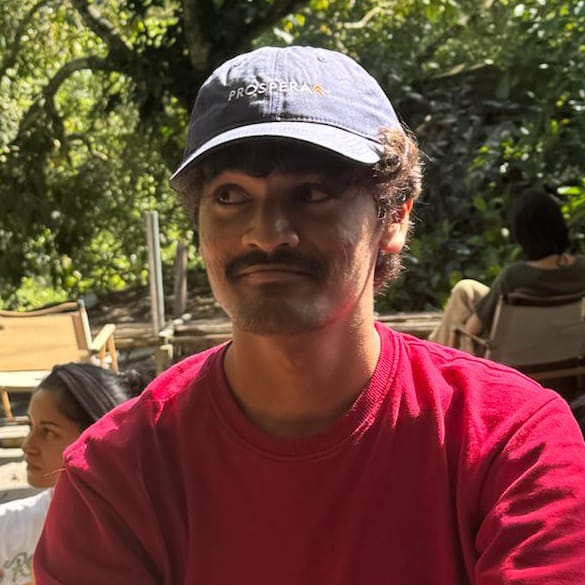
Hi! My name is Sahil from India. I am self-studying mathematics and computer science with a research-oriented mindset. My work is guided by a strong interest in David Deutsch's four strands of explanations, which inform how I approach learning and problem-solving and life in general.
I build learning tools as a means of understanding deep concepts. Each project is an opportunity to test ideas, refine explanations, and develop better mental models.
Skills.
Programming Languages
Tools & Technologies
Quantum Computing
Web & Blockchain
Mathematics & Physics
Soft Skills
Philosophy.
My approach to life, learning and research is grounded in critical rationalism. I believe that knowledge grows through a process of conjecture, explanation, testing, and refinement; not through appeals to authority or credential-seeking.
"Good explanations are hard to vary while still accounting for what they purport to account for."
"Problems are inevitable; Problems are soluble."
Explanations over authority: understanding trumps memorization.
Mathematics and computation as tools for building explanatory models.
Learning is iterative: conjecture, test, refine, repeat.
Credentials document past work; explanations demonstrate current understanding.
Quotes to Live by.
"Jôdi Tor Dak Shune Keu Na Ase Tôbe Ekla Chôlo Re"
— Rabindranath Tagore
"Tradition is not worship of the ashes, but it is the preservation of fire."
— Gustav Mahler
"My pencil and I are more clever than I."
— A. Einstein
"I want to put a dent in the universe."
— Steve Jobs
"The only rules are the ones dictated by the laws of physics. Everything else is just a recommendation."
— Elon Musk
"Philosophy is where our knowledge ends."
— Anonymous
"A wise old owl lived in an oak, The more he saw the less he spoke, The less he spoke, the more he heard, Why aren't we all like that wise old bird?"
— John D. Rockefeller
"Don't be trivial."
— Paul Erdös
"One lives and learns, I guess."
— Douglas R. Hofstadter
Work & Collaboration.
Content Collaboration
Working with a content creator on content ideation and conceptual development.
Vibe-coding
Building projects that combine high-level aesthetics with functional, intent-driven implementation.
Volunteer Roles
IBM Qiskit Advocate (Quantum education) and Gauss Scholar (Mathematical initiatives).
Self-Research & Projects.
Jake or Fake
A fast-paced trivia game designed for interactive content audiences.
FileFix
A streamlined solution for Indian students managing examination document uploads.
Busy Beaver for Tag Systems
An empirical study of how the Busy Beaver function behaves on Post tag systems.
Prompt Quantification
Researching how to get the most sophisticated and original results from AI.
DocCheck
A client-side "git diff" for documents that flags unauthorized tampering in PDFs and DOCX.
Network State Constitutions
A Network School lecture on constitutional design for Network States, with a critical stance.
Learning Haskell
A collection of Haskell projects built from scratch while learning the language.
Notes & Explorations.
Explanatory Power
Discusses how an explanation (like E=mc²) provides a hard-to-vary account of reality rather than just fitting data. Focuses on why understanding matters more than correlation.
λSK Combinators & Computational Universality
Explores how complex behavior emerges from simple rules (S and K combinators) and references Wolfram’s principle of computational equivalence. Analyzing the irreducible nature of logic.
Wolfram Physics Project & Hypergraphs
Covers the emergence of spacetime from hypergraph evolution, causal invariance, and the idea that the universe is essentially a computational system evolving over time.
Isomorphism & Structural Identity
Analyzes structural identity in mathematics, arguing that objects matter only up to isomorphism and that structure, not substance, determines what a mathematical entity truly is.
Connection.
Learning Loops
Direct Access
© 2026 Sahil Ohe.